Level-2 (Super-) Facilities
Goal of this page
Opt into two-level facility assignment: mark level-2 candidates,
enable SuperFacilityAssignment, bias the supergraph cut toward good
hub locations, and read the result.
FalcomChain supports two-level hierarchical facility location: each
superdistrict (a group of level-1 districts) can host a level-2
facility chosen from its own candidate set F². Level-2 facility
assignment is opt-in and soft: you only compute it if you ask
for it, and superdistricts with no eligible candidate simply get no
level-2 facility.
This page walks through the level-2 workflow on the shared demo grid.
The candidate sets are independent
Eq. 18 in the paper defines F² ⊂ V¹ — level-2 candidates are nodes of
the base graph, not a subset of the level-1 facility set F¹. They
are an independent property of nodes:
candidate=1→ eligible to host a level-1 facilitysuper_candidate=1→ eligible to host a level-2 facility
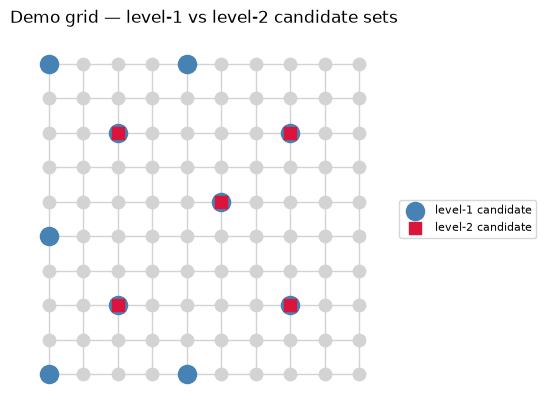
A node can be either, both, or neither. The shared demo grid has about 30 level-1 candidates and 5 level-2 candidates, with several overlapping — the visualization makes the independence clear.
import json
import networkx as nx

with open("_static/demo_grid_10x10.json") as f:
    data = json.load(f)
graph = nx.node_link_graph(data, edges="links")

n_l1 = sum(1 for n, d in graph.nodes(data=True) if d.get("candidate"))
n_l2 = sum(1 for n, d in graph.nodes(data=True) if d.get("super_candidate"))
n_both = sum(
    1 for n, d in graph.nodes(data=True)
    if d.get("candidate") and d.get("super_candidate")
)
print(f"level-1 candidates:   {n_l1}")
print(f"level-2 candidates:   {n_l2}")
print(f"overlap (both):       {n_both}")
level-1 candidates:   10
level-2 candidates:   5
overlap (both):       5
Plotting both candidate layers
Two markers stacked: blue circles for level-1 candidates, red squares
for level-2 candidates. Overlapping nodes show both. We use
:func:falcomplot.plot_grid from the
FalcomPlot companion
library — same helper used across the FalcomChain docs.
from falcomplot import plot_grid

plot_grid(graph, title="Demo grid — level-1 vs level-2 candidate sets");
Opting into level-2 facility assignment
By default, state.super_facility is None. To enable Eq. 18, pass
super_facility_fn=SuperFacilityAssignment.from_state to
ChainState.initial:
from falcomchain import Partition, SuperFacilityAssignment
from falcomchain.markovchain.state import ChainState
from falcomchain.partition.assignment import Assignment
from falcomchain.random import set_seed

set_seed(42)

# Manhattan-distance travel times on the grid.
Assignment.travel_times = {
    (a, b): float(abs(graph.nodes[a]["C_X"] - graph.nodes[b]["C_X"])
                  + abs(graph.nodes[a]["C_Y"] - graph.nodes[b]["C_Y"]))
    for a in graph.nodes for b in graph.nodes
}

# Seed on the achievable per-team load total / k (k = ceil(total / w)),
# not the raw target w; keep capacities in the safe range c in {1, 2}.
import math
_total = sum(d["demand"] for _, d in graph.nodes(data=True))
seed_demand_target = _total / max(1, math.ceil(_total / 1000))

partition = Partition.from_random_assignment(
    graph=graph,
    epsilon=0.3,
    demand_target=seed_demand_target,
    assignment_class=None,
    capacity_level=2,
)

state = ChainState.initial(
    partition=partition,
    energy=0.0,
    beta=1.0,
    super_facility_fn=SuperFacilityAssignment.from_state,
)
state.super_facility
<SuperFacilityAssignment [5 superdistricts]>
Inspecting the level-2 assignment
In the initial partition, the super_assignment is identity — each
level-1 district is its own superdistrict. So the level-2 facility for
superdistrict s is just the best super-candidate inside that one
level-1 district.
print(f"Number of level-1 districts:        {len(partition.parts)}")
print(f"Number of superdistricts:           {len(partition.super_parts)}")
print(f"Superdistricts with a level-2 fac.: {len(state.super_facility.centers)}")
print(f"Superdistricts without (soft skip): "
      f"{len(partition.super_parts) - len(state.super_facility.centers)}")
Number of level-1 districts:        5
Number of superdistricts:           5
Superdistricts with a level-2 fac.: 5
Superdistricts without (soft skip): 0
plot_grid(
    graph,
    title="Initial partition — level-2 facilities (black rings)",
    super_centers=state.super_facility.centers.values(),
);
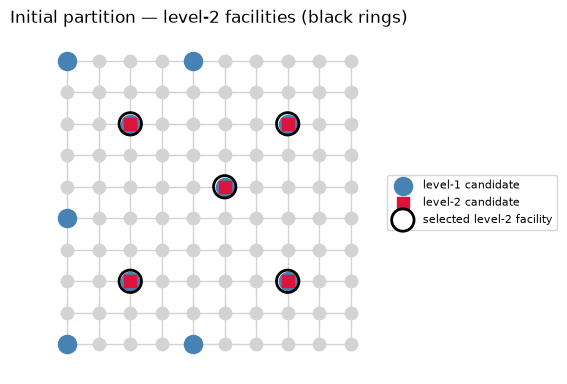
The black rings mark superdistricts where a level-2 facility was selected (a super-candidate exists in that superdistrict). Other superdistricts have no level-2 facility — that’s the soft constraint in action.
After a chain step the picture changes
After hierarchical_recom, the supergraph is repartitioned and some
level-1 districts get grouped into multi-district superdistricts. Each
group now has more base nodes to consider, so the level-2 selection
can place a facility serving a wider area.
from falcomchain import hierarchical_recom

set_seed(7)
new_state = hierarchical_recom(
    state, epsilon_base=0.3, epsilon_super=0.3, demand_target=1000,
)
print(f"new superdistricts:          {len(new_state.partition.super_parts)}")
print(f"with a level-2 facility:     {len(new_state.super_facility.centers)}")
print(f"sample super_parts (first 3):")
for sid, l1_ids in list(new_state.partition.super_parts.items())[:3]:
    print(f"  super_id {sid}: level-1 districts {sorted(l1_ids)}")
new superdistricts:          2
with a level-2 facility:     2
sample super_parts (first 3):
  super_id 1: level-1 districts [3, 4, 5]
  super_id 2: level-1 districts [1, 2]
The full two-level picture — district colors, level-1 facility stars with team counts, super-district boundaries (thick black edges), and level-2 facility diamonds:
from falcomplot import plot_partition

plot_partition(
    graph, new_state,
    title="After one hierarchical step — both facility tiers",
    demand_target=1000, c_min=1, c_max=2, epsilon=0.3,
    demand_target_super=1000, c_max_super=2, epsilon_super=0.3,
);
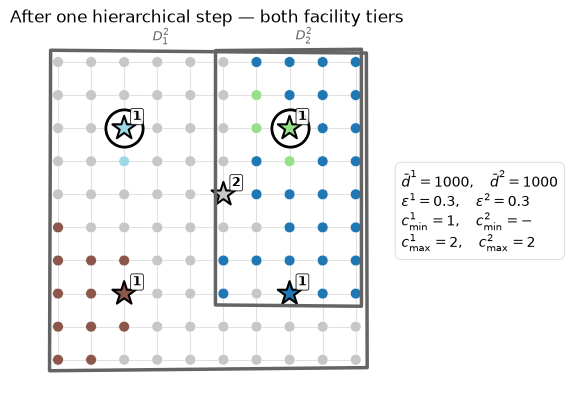
Superdistricts spanning several level-1 districts are outlined by the thick boundary; each carries one diamond (its level-2 facility) as long as a super-candidate exists inside it.
A custom selector
SuperFacilityAssignment.from_state takes a selection_fn callable.
The default is :func:minimax_super_selector (Eq. 18). You can plug in
any function with the same signature — e.g., demand-weighted minimax,
or a tie-breaker that prefers certain candidates.
from falcomchain.markovchain.facility import minimax_super_selector

def demand_weighted_super_selector(super_id, super_candidates, base_nodes,
                                   travel_times):
    """Pick c minimizing max(demand[v] * dist(c, v)) over base_nodes."""
    # ... your logic ...

state = ChainState.initial(
    partition=partition,
    energy=0.0,
    beta=1.0,
    super_facility_fn=lambda s: SuperFacilityAssignment.from_state(
        s, selection_fn=demand_weighted_super_selector
    ),
)
Biasing the supergraph cut toward good level-2 candidates
The level-2 facility assignment (above) runs after the supergraph
partition has been chosen. To also bias the cut selection itself
toward subtrees that admit well-located level-2 candidates, pass
gamma_super > 0 to :func:hierarchical_recom. With γ² > 0 the
chain uses the paper’s hub-coherence score (Eq. 22, 27):
ψ²(T_u) = ϕ²(T_u) · exp(-γ² · π²(T_u))
π²(T_u) = min_{f ∈ F² ∩ V¹[T_u]} max_{v ∈ V(T_u)} d(f, f¹(D_v¹))
For each super-candidate f in the subtree, the inner max is the
worst-case distance from f to any level-1 facility center in T_u.
The outer min picks the candidate with smallest such eccentricity.
Subtrees with no super-candidate get π² = +∞ and are filtered out
(soft level-2 constraint, paper Section 5.5).
from falcomchain import hierarchical_recom
from functools import partial

proposal = partial(
    hierarchical_recom,
    epsilon_base=0.1,
    epsilon_super=0.15,
    demand_target=1500,
    gamma_super=1.0,    # 0 = uniform; large = greedy on hub-coherence
)
For a custom level-2 cut score, pass super_psi_fn directly — a
callable (subnodes, teams) -> float. See
:func:hub_coherence_psi_factory for the default implementation
pattern.
Using super_facility in ensemble analysis
If super_facility_fn is set, state.super_facility.centers is part
of every sample. The ensemble’s super_facility_frequencies (in the
report from :class:EnsembleStats) counts how often each
super-candidate is selected across the chain — the level-2 analog of
the level-1 facility stability metric.
When super_facility_fn=None (default), state.super_facility is
None, and the ensemble’s super_facility_frequencies stays empty.
API reference
SuperFacilityAssignment.from_state(state, selection_fn=None)
Compute level-2 facilities for every superdistrict in
state.partition.super_parts. Soft-skips superdistricts whose
constituent base nodes contain no super-candidate.
selection_fn— callable(super_id, super_candidates, base_nodes, travel_times) -> (node, radius). Default: :func:minimax_super_selector.
minimax_super_selector(super_id, super_candidates, base_nodes, travel_times)
The default Eq. 18 minimax: pick the super-candidate minimizing the
maximum travel time to any base node in the superdistrict. Returns
(best_candidate, covering_radius).
ChainState.initial(..., super_facility_fn=None)
super_facility_fn=None (default) ⇒ state.super_facility is None
for the whole chain. Pass SuperFacilityAssignment.from_state (or any
custom callable taking a ChainState and returning a
SuperFacilityAssignment) to enable.