Fixed Superdistricts
Goal of this page
An advanced variant: hold an externally given level-2 partition (health zones, sales territories) fixed while the chain explores level-1 districtings within each zone. Most users want the default resampling mode instead.
Real-world hierarchical problems often come with the upper-level partition already given — health zones, sales territories, school districts. In those cases, you don’t want the chain to resample the level-2 partition every step; you want it to explore level-1 districtings within each fixed zone.
FalcomChain supports this via:
Partition.from_random_assignment(super_assignment=...)— build the initial partition by partitioning each zone independently.hierarchical_recom(super_partitioner=fixed_super_partition)— run the chain with the level-2 partition held fixed.
Setting up the zones
This page uses a small uniform-demand 10×6 synthetic grid, not the shared heterogeneous demo grid. Reason: the demo grid has 5 high-demand “city centers” that make balanced zone-based partitioning very hard (bipartition_tree fails to find admissible cuts). With uniform demand the per-zone arithmetic is simple and the demo is illustrative.
We split the grid into a left zone (A) and a right zone (B) at
x = 5.
from falcomchain.graph.grid import Grid
from falcomchain.random import set_seed

set_seed(42)
graph = Grid(
    dimensions=(10, 6), num_candidates=20, density="uniform",
).graph

zones = {
    n: ("A" if n[0] < 5 else "B")
    for n in graph.nodes
}
print(f"zone A: {sum(1 for v in zones.values() if v == 'A')} nodes")
print(f"zone B: {sum(1 for v in zones.values() if v == 'B')} nodes")
zone A: 30 nodes
zone B: 30 nodes
Building the initial partition
from falcomchain import Partition
from falcomchain.partition.assignment import Assignment

set_seed(42)
Assignment.travel_times = None  # not needed for this demo

# Seed on the achievable per-team load total / k (k = ceil(total / w)),
# not the raw target w; keep capacities in the safe range c in {1, 2}.
import math
_total = sum(d["demand"] for _, d in graph.nodes(data=True))
seed_demand_target = _total / max(1, math.ceil(_total / 500))

partition = Partition.from_random_assignment(
    graph=graph,
    epsilon=0.3,
    demand_target=seed_demand_target,
    assignment_class=None,
    capacity_level=2,
    super_assignment=zones,
)

print(f"superdistricts:    {sorted(partition.super_parts.keys())}")
print(f"level-1 districts: {len(partition.parts)}")
for super_id, l1_ids in partition.super_parts.items():
    print(f"  zone {super_id!r}: {len(l1_ids)} level-1 district(s)")
superdistricts:    ['A', 'B']
level-1 districts: 5
  zone 'A': 3 level-1 district(s)
  zone 'B': 2 level-1 district(s)
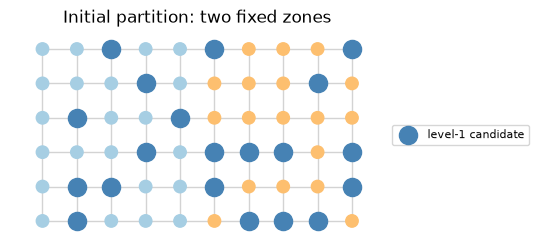
Every level-1 district lies entirely inside one zone — the partition respects the zone boundaries by construction.
Visualizing the fixed zones
We pass per-node colors to :func:falcomplot.plot_grid — base nodes
are tinted by zone, and level-1 candidates are overlaid as blue
circles by the helper.
from falcomplot import plot_grid

zone_colors = {"A": "#a6cee3", "B": "#fdbf6f"}
node_to_l1 = partition.assignment.mapping
node_color_map = {
    n: zone_colors[partition.super_assignment[node_to_l1[n]]]
    for n in graph.nodes
}

plot_grid(
    graph,
    title="Initial partition: two fixed zones",
    node_colors=node_color_map,
    show_level2_candidates=False,
);
Running the chain with fixed superdistricts
fixed_super_partition keeps partition.super_assignment constant
across steps. Each step picks one zone uniformly and re-partitions the
level-1 districts within it.
from falcomchain import hierarchical_recom
from falcomchain.markovchain.state import ChainState
from falcomchain.markovchain.super_partitioners import fixed_super_partition

# travel_times is required for the level-1 facility minimax (Eq. 17).
Assignment.travel_times = {
    (a, b): float(
        abs(graph.nodes[a]["C_X"] - graph.nodes[b]["C_X"])
        + abs(graph.nodes[a]["C_Y"] - graph.nodes[b]["C_Y"])
    )
    for a in graph.nodes for b in graph.nodes
}

state = ChainState.initial(partition=partition, energy=0.0, beta=1.0)
print("Before any step:")
print(f"  super_parts keys: {sorted(state.partition.super_parts.keys())}")

set_seed(7)
new_state = hierarchical_recom(
    state,
    epsilon_base=0.3,
    epsilon_super=0.3,
    demand_target=500,
    super_partitioner=fixed_super_partition,
)
print("After one fixed-superdistrict step:")
print(f"  super_parts keys: {sorted(new_state.partition.super_parts.keys())}")
print(f"  level-1 districts: {len(new_state.partition.parts)}")
Before any step:
  super_parts keys: ['A', 'B']
After one fixed-superdistrict step:
  super_parts keys: ['A', 'B']
  level-1 districts: 5
Same set of zones, level-1 districts have been resampled within whichever zone was picked.
Contrast: resample mode changes super_parts
For comparison, the default resample_super_partition builds a fresh
level-2 partition each step. With this small graph the resampled
partition typically has the same number of superdistricts as level-1
districts (each level-1 district becomes its own superdistrict), so
the result is materially different from the fixed-zone case.
from falcomchain.markovchain.super_partitioners import resample_super_partition

# Use a non-zone partition to compare apples to apples.
set_seed(42)
plain_partition = Partition.from_random_assignment(
    graph=graph, epsilon=0.3, demand_target=seed_demand_target,
    assignment_class=None, capacity_level=2,
)
plain_state = ChainState.initial(
    partition=plain_partition, energy=0.0, beta=1.0
)

set_seed(8)
resampled_state = hierarchical_recom(
    plain_state,
    epsilon_base=0.3,
    epsilon_super=0.3,
    demand_target=500,
    super_partitioner=resample_super_partition,
)
print(f"Initial super_parts:    {len(plain_state.partition.super_parts)}")
print(f"After resample step:    {len(resampled_state.partition.super_parts)}")
Initial super_parts:    5
After resample step:    2
When to use fixed superdistricts
Use fixed_super_partition when:
Superdistricts are policy-defined (zones, regions, watersheds).
You want the ensemble to characterize level-1 uncertainty within each fixed zone, not joint uncertainty over both levels.
The level-2 facility ensemble is meaningful only relative to the given zones.
Use resample_super_partition (default) when:
The hierarchical structure itself is part of what you’re sampling.
You want a free joint ensemble over level-1 and level-2 partitions.
A note on ensemble analysis under fixed superdistricts
When the level-2 partition is fixed, the boundaries between zones
appear as boundaries in every sample — so they have boundary
frequency 1.0 and look “robust” in :class:EnsembleStats.boundary.
That’s correct but not informative: those boundaries are policy
inputs, not chain findings. When reporting robust boundaries, filter
out edges whose endpoints lie in different zones:
inter_zone = {
    (u, v) for u, v in graph.edges()
    if zones[u] != zones[v]
}
robust_within_zone = {
    e: f for e, f in ensemble.boundary.robust(0.9).items()
    if e not in inter_zone and (e[1], e[0]) not in inter_zone
}
API reference
Partition.from_random_assignment(..., super_assignment=None)
When super_assignment is provided, it must be a dict mapping every
base node to a superdistrict ID. The function partitions each zone
independently and stitches the results, with renumbered level-1 IDs
to avoid collisions across zones. The returned partition has its
super_assignment set to the user-provided zoning (mapping level-1
IDs to zone IDs).
fixed_super_partition(state, epsilon, demand_target, density=None, recorder=None)
Picks one superdistrict uniformly at random from
state.partition.super_parts, returns the level-1 IDs in it as the
merge set, and carries the parent’s super_assignment forward
unchanged. Raises ValueError if super_parts is empty.